Explained by Right & Associates – Nepal’s Expert Australia Consultancy
As Right & Associates, one of the best education consultancies in Nepal for Australia, our counsellors are asked every day:
After Australia moved Nepal to Assessment Level 3 and tightened Genuine Student (GS) checks, English test scores—especially PTE Academic—now play an even bigger role in both admission and visa decisions.
This guide explains, in clear language, how we at Right & Associates look at PTE score requirements for 2026, how they link to your course and visa, and what strategy we recommend for Nepali students.
PTE Score Requirements 2026
PTE for Australia in 2026: The Big Picture
Australia accepts PTE Academic for:
- University and college admissions, and
- Student visa applications (Subclass 500), alongside IELTS and other recognized tests.
In 2026, with Level 3 for Nepal, we see three key trends:
- Institutions and visa officers pay more attention to whether your PTE score matches your chosen course level.
- Borderline scores that barely meet the minimum can make GS and visa assessments stricter.
- Strong PTE scores now help overall credibility, especially when your academics or finances are not perfect.
This is why, as Right & Associates, we tell students: “Aim above the bare minimum” instead of just chasing the lowest possible PTE score.
Learn about our English Test Preparation (PTE & IELTS): https://rassociates.edu.np/services/english-test-preparation
Typical PTE Cut-offs by Course Level (Indicative)
Exact score requirements vary by university, college and course. However, from our day-to-day admission work, this is a general pattern we see for Australia:
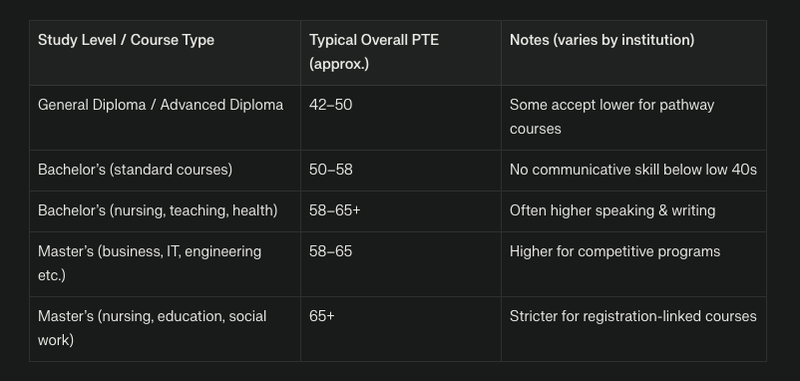
These are admission ranges, not visa guarantees. Visa officers see your PTE score as proof you can handle your course and are a genuine student.
PTE Score and Visa: Why Level 3 Makes It More Important
Under Assessment Level 3, case officers reading your GS and visa file will consider:
- Is your English score clearly sufficient for your course and provider?
- Does your PTE score match the academic difficulty and your past results?
- If you are applying for nursing, teaching or other regulated fields, is your English at the expected standard?
Weak or just-barely-enough PTE scores, combined with average academics or complex finances, can increase refusal risk.
At Right & Associates, we now encourage many Australia-intent students to retake PTE or IELTS if their scores are clearly below what their target course consistently accepts.
PTE vs IELTS for Australia in 2026 – Our Perspective
Both PTE Academic and IELTS Academic are widely accepted in Australia. From a practical standpoint, this is how we see them:
- PTE Academic
- Fully computer-based.
- Often easier for students who are comfortable with typing and fast tasks.
- Popular among Nepali students aiming for Australia and New Zealand.
- IELTS Academic
- Paper/computer-based, with in-person speaking.
- Preferred in some specific institutions and registration bodies.
Right & Associates does not push one blindly. Instead, counsellors and trainers:
- Assess your strengths (speaking, writing, typing, listening).
- Check the requirements of your target courses/universities.
- Then recommend whether PTE or IELTS is more strategic for you.
Recommended PTE Targets by Profile (Right & Associates View)
To stay safe in a Level 3 environment, we often suggest these target ranges for Nepali students:
- General Bachelor’s / Diploma Applicants:
- Aim for PTE 52–58+ even if some providers accept 42–50.
- Masters (Business / IT / Engineering):
- Aim for PTE 58–65 to keep more options open.
- Nursing / Teaching / Health / Social Work:
- Aim for PTE 65+, with strong Speaking and Writing.
- Profiles with Gaps / Older Age / Past Refusals:
- Stronger English (higher PTE band) can help offset other weaknesses when combined with solid GS and financials.
We treat these as internal safety targets, not as hard rules, because each case is individually assessed by our counsellors and visa team.
How Right & Associates Trains Students for PTE in 2026
Across branches (Putalisadak, Kumaripati, Chitwan, Pokhara, Butwal, Bardaghat, Kawasoti, Damauli, Hetauda), our PTE preparation follows a common framework:
Step 1: Diagnostic Assessment
- Short test to see current level in speaking, writing, listening and reading.
- Based on this, trainers set a realistic target band and timeframe.
Step 2: Skill-Based Training
- Speaking: fluency, pronunciation, content development.
- Writing: essay structure, summarizing text, grammar and vocabulary.
- Listening & Reading: question-type strategies, time management, note-taking.
Step 3: Exam Strategy
- Task prioritization based on scoring weight.
- Time management for integrated tasks.
- Practice on PTE-style software interfaces.
Step 4: Mock Tests & Feedback
- Full-length timed mocks.
- Individual feedback with specific action points (e.g., “focus on speaking fluency rather than over-thinking vocabulary”).
All this is integrated with your Australia plan, not done in isolation.
Linking PTE Scores with Course & Visa Strategy
At Right & Associates, we never treat PTE as a separate activity. We connect it to:
- Your course choice – some programs need higher English, especially health, teaching, and migration-linked courses.
- Provider type – higher-ranked institutions often prefer higher PTE.
- Visa & GS – strong PTE helps show you are a genuine student prepared for academic demands.
During counselling, we clearly explain whether your current PTE score is strong enough for:
- Admission only, or
- Both admission and a convincing visa file under Level 3.
If not, we suggest realistic retake plans rather than pushing weak files.